
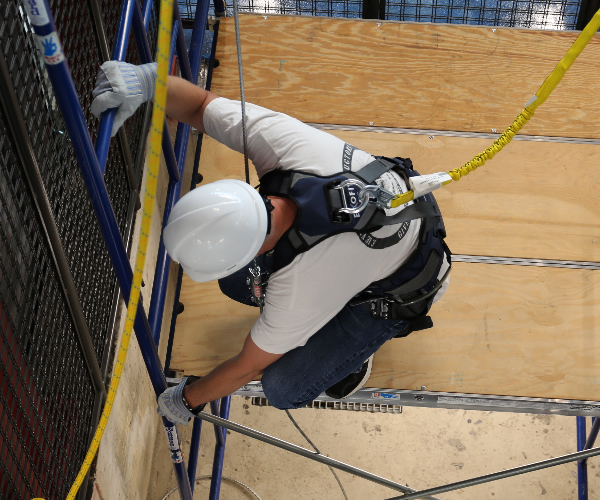
Understanding Fall Protection: Prevention, Arrest, and Rescue
Working at height is part of the job for Elevator Constructors, but it doesn’t have to be part of the risk. Falls remain one of the leading causes of serious injury and death in construction and general industry each year, and the elevator trade is no exception. Fall protection is not just a regulatory requirement, it’s a system of prevention, engineering controls, training, and emergency preparedness designed to make sure every worker goes home safely at the end of the day.
In the elevator industry, we encounter fall hazards around hoistways, on platforms, on rooftops, and in machine rooms. To address these risks effectively, we need to understand the differences between fall prevention and fall arrest, how anchorage decisions affect survival, and why a rescue plan matters just as much as a harness and lanyard.
Start With Prevention: Barricades and Guardrails
The most effective fall protection strategy is preventing the fall from ever occurring. Barricades and guardrails are foundational tools in that effort.
- Barricades restrict access to dangerous areas such as open hoistways, or unfinished platforms.
- Guardrails physically prevent falls by creating a stable barrier at an edge or elevation.
Properly installed guardrails are your best protection. When they are missing, damaged, or insufficient, personal fall protection systems become necessary.
Fall Restraint vs. Fall Arrest: Knowing the Difference
When engineering controls cannot prevent exposure, personal fall protection systems fill the gap. OSHA recognizes two primary categories:
Fall Restraint Systems
These systems prevent the worker from reaching the fall hazard. A restraint lanyard will limit travel to ensure the worker cannot physically get to the edge of a hazard. This is still considered prevention — it stops the fall from starting.
Fall Arrest Systems (PFAS)
Fall arrest systems stop a fall in progress. A Personal Fall Arrest System typically includes:
- A full-body harness
- A shock-absorbing lanyard or self-retracting lifeline (SRL)
- An anchorage point rated for fall arrest forces
Both systems reduce risk, but only PFAS is designed to safely arrest a fall. And for PFAS, anchorage selection matters more than many workers realize.
Anchorage Requirements: The Critical Weak Link
A PFAS is only as strong as the point it anchors to. OSHA’s guidelines on fall protection includes strict criteria for fall arrest anchorages, found in 29 CFR 1926.502(d)(15). According to OSHA §1926.502(d)(15), every anchorage point used for fall arrest must:
- Be independent of any anchorage used to support or suspend platforms
- Support at least 5,000 pounds per employee attached, or
- Be part of a system with a minimum safety factor of two, designed and supervised by a qualified person.
In addition, PFAS must be rigged so that the worker:
- Cannot free fall more than 6 feet for construction or 4 feet for general industry
- Cannot contact a lower level
- Is subjected to no more than 1,800 pounds of arresting force
These criteria are essential because uncontrolled deceleration and improper anchorage are major contributors to severe fall injuries. Choosing a “strong-looking” structural member is not enough. Qualified individuals must ensure anchors are capable and correctly installed.
Common anchorage mistakes include:
- Anchoring to conduit, pipes, handrails, or lightweight grating
- Using platform suspension points instead of independent arrest points
- Anchoring above sharp edges without proper SRL or padding
- Anchoring below the harness D-ring, increasing free fall distance
The Often Overlooked Piece: Rescue Planning
Stopping a fall is only half the problem; the other half is what happens next.
OSHA §1926.502(d)(20) requires employers to provide for prompt rescue or ensure employees are able to rescue themselves. Even with the best equipment, you must plan for what happens after a fall. Rescue must be quick. Every minute counts.
Suspension trauma, also called orthostatic intolerance, can set in rapidly. Research indicates that a suspended worker can lose consciousness in less than 30 minutes. Be aware of the warning signs including faintness, dizziness, nausea, sweating, pale complexion, low blood pressure, and visual dimming.
OSHA recommends that a rescue plan include procedures for:
- Preventing prolonged suspension (e.g., trauma straps, self-rescue devices)
- Identifying orthostatic intolerance symptoms
- Ensuring trained personnel and equipment are available
- Executing rapid retrieval and treatment
- Understanding first aid considerations post-rescue
A rescue plan without equipment and training is not a plan. Elevator crews should review rescue scenarios for hoistways, rooftops, and machine rooms during job hazard analysis and site-specific orientation.
Why This Matters for Elevator Constructors
Prevention begins long before a harness is buckled. It starts with site assessment, barricades, and guarding. When those controls cannot eliminate exposure, understanding the difference between restraint and arrest, and selecting appropriate anchorage, can save a life. Finally, no discussion of fall protection is complete without a plan to rescue the worker who has fallen, because stopping the fall is only half the battle.
By reinforcing these practices across the apprenticeship and continuing education courses, NEIEP continues to prepare Elevator Constructors for safer careers on every floor of the job.